


Key Principles in Practice
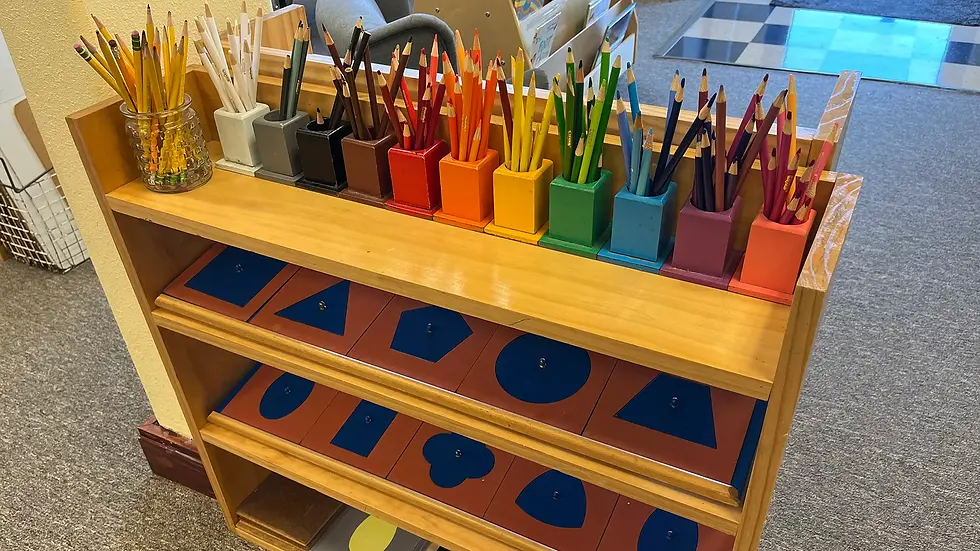
The Prepared Environment
The carefully designed Montessori environment is the cornerstone of the method, functioning as a "third teacher" (the first is the child, the second is the adult) that enables independent learning and exploration. Unlike conventional classrooms centered around the teacher's desk, Montessori environments are designed around the child's developmental needs.
This prepared environment includes:
Child-sized furniture and accessible materials designed for independent use
Beauty, order, and simplicity that invite engagement
Materials arranged sequentially from simple to complex
A complete range of activities to serve all developmental needs
Furnishings and tools that allow children to care for the environment themselves
The most visibly obvious difference in the Montessori classroom are the scientifically designed materials that embody abstract concepts in concrete form. These materials:
Allow children to literally grasp ideas before working with them symbolically
Include built-in "control of error" enabling self-correction without adult intervention
Isolate one quality or concept at a time for clarity of understanding
Follow a carefully sequenced progression from concrete to abstract
Build independence by requiring minimal adult assistance
This environment serves as both laboratory and workshop, enabling children to independently select meaningful work, discover concepts through hands-on exploration, and progress at their own pace without constant adult direction. As understanding develops, children naturally move from concrete materials to more abstract representations, eventually working without materials at all.
Mixed-Age Communities
Montessori communities are an integral part of the prepared environment itself and create a social environment that supports development in ways single-age groupings cannot;
Younger children observe and learn from older peers, aspiring to more advanced work
Older children reinforce their knowledge by teaching younger ones
Leadership opportunities emerge naturally rather than being artificially assigned
Children can progress at their own pace without the stigma of being "ahead" or "behind"
A stable community forms as only a portion of the class changes each year
Teacher-student relationships deepen through multiple years of working together
The three-year cycle allows children to experience being the youngest, middle, and oldest in their community, naturally developing different social skills and perspectives in each position. This community becomes a microcosm of society where children learn to navigate complex social dynamics with guidance but without constant adult intervention.
Observation
Observation is both the foundation and the ongoing practice of Montessori education. Just as Dr. Montessori developed her method through scientific observation, Montessori teachers continually refine their guidance through careful observation of each child.
The scientific observation differs from casual watching:
It is systematic and regular, not random or occasional
It focuses on identifying developmental needs and readiness
It requires trained perception to recognize subtle signs of developments
It informs when and how to introduce new materials or concepts
It helps teachers determine when to intervene and when to step back
Montessori educators maintain detailed records of observations, tracking each child's interests, challenges, progress, and developmental trajectory. These observations guide individualized lessons and help maintain the delicate balance between freedom and guidance.
Observation extends beyond academic progress to encompass social development, emotional well-being, and the formation of character. By observing closely, teachers can support not just what children learn, but how they develop as complete human beings.
This practice of scientific observation is one of the most distinctive features of authentic Montessori education and requires significant training and experience to master.
Freedom (Within Limits)
Montessori education balances freedom and structure. Children have genuine choices within carefully established boundaries:
Freedom to choose activities from those they've been introduced to
Freedom to work for extended periods without interrupted
Freedom to work alone or collaborate
Freedom to move around the classroom purposefully
These freedom are balanced with clear expectations:
Respect for others and the environment
Proper use and care of materials
Completion of chosen work
Adherence to classroom ground rules
This balance fosters internal discipline rather than compliance with external authority. Children develop self-regulation by having meaningful choices and experiencing the natural consequences of those choices.
Freedom of Time: The Uninterrupted Work Periods
One of the most distinctive freedoms in Montessori education is freedom of time. Long, uninterrupted blocks - typically three hours - allow children to:
Enter a state of deep concentration without arbitrary interruptions
Follow their natural rhythms of engagement
Complete complex, multi-step activities from start to finish
Work through challenges that require sustained effort
Experience the profound satisfaction of self-directed accomplishment
These extended work periods contrast sharply with conventional school schedules where children switch activities every 30-45 minutes regardless of interest or engagement. The uninterrupted work period respects the child's internal timing rather than imposing artificial transitions that can fragment learning and disrupt concentration.
By protecting this time, Montessori environments allow for the development of executive functions skills, persistence, and the ability to enter a flow state - deeply satisfying experience of complete absorption in meaningful activity that research associates with optimal learning and happiness.
(Montessori Education - Post 5)


Comments